
One small step forward.
How to Get Over a Mental Block and Start Moving Forward
A calm, practical way to reduce overwhelm, find one manageable next action, and begin moving forward.
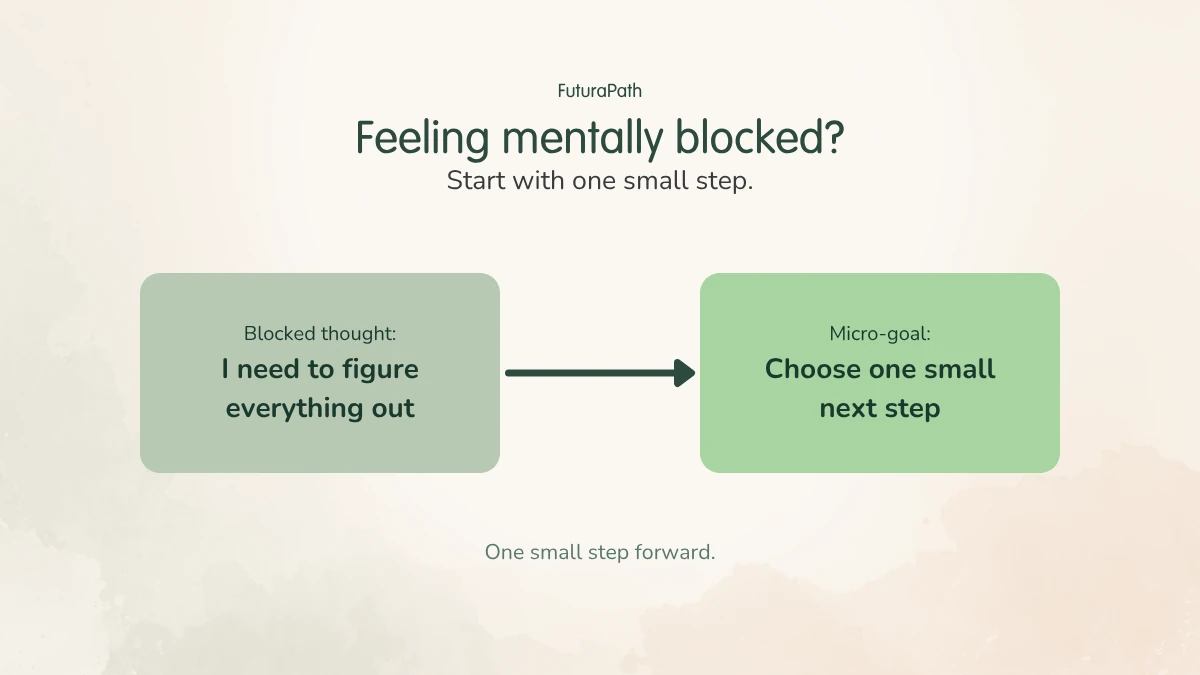
To get over a mental block, reduce the size of the decision in front of you. Identify one small, specific action you can complete without needing to solve the entire problem.
You may care about the outcome and still feel foggy, overloaded, or unable to choose a next step. That does not automatically mean you are lazy or unmotivated. Often, the next action is carrying too much pressure or is not clear enough yet.
This article uses mental block as plain language for the experience of feeling stuck, not as a medical or psychological diagnosis.
What is one small step I can take next?
That question does not ask you to solve everything. It asks you to create a small opening.
If overwhelm already feels louder than the task itself, try a calmer way to start when everything feels overwhelming before you plan.
What Is a Mental Block?
A mental block is the experience of wanting to move forward while your attention keeps circling the same stuck point. Even a task you care about can feel difficult to begin.
Often, the block is not proof that something is wrong with you. It is a signal that the goal may be carrying too much pressure, too much vagueness, too many decisions, or too much uncertainty.
Instead of judging the block, it helps to ask what the block is showing you about the next action.
A mental block often points toward things like:
- pressure to do it perfectly
- a goal that is too broad to act on
- too many possible starting points
- uncertainty about what matters most right now
- emotional weight attached to the outcome
The goal is not to force yourself past the block by brute strength.
The goal is to make the next action easier to see.
Why Mental Blocks Happen
Many blocked thoughts sound meaningful but do not tell you what to do next. Statements such as I need to work on my business or I need to figure everything out describe an outcome, not a usable action.
When your mind already feels stuck, demanding a full plan can add pressure. You may ask for more motivation, certainty, or discipline, but bigger expectations often make the starting point harder to see.
Vagueness, too many choices, fear of doing the work poorly, and uncertainty about what matters most can all make one task feel much larger than it is.
Unclear outcome -> more pressure -> harder starting point -> more avoidance -> more pressure
Pushing harder is not always the most useful response. Sometimes the calmer move is to reduce the weight of the next decision.
How to Get Over a Mental Block
Start by changing the question. Instead of asking how to solve the whole situation, ask what one small step you can take next.
Then make the answer specific and visible. Open the document is easier to act on than work on the report. Put walking shoes by the door is clearer than get healthier.
The action does not need to be impressive. It needs to be small enough to begin and meaningful enough to point in the right direction.
You are not lowering the importance of the outcome. You are creating a practical entry point into it.
How to Get Past a Mental Block When You Feel Stuck
If the first small step still feels resistant, shrink it again without turning that into a failure story.
Write the report can become open the document. Go for a walk can become put shoes by the door. Plan the week can become write one thing that matters tomorrow.
You also do not need to wait for perfect confidence. A modest, imperfect start can be enough to reveal what comes next.
Making the step smaller does not make the goal less important. It makes starting more possible.
Reduce a Large Problem to One Manageable Next Action
Separate the desired outcome from the immediate action. The outcome might be prepare for a career change; the action might be open the resume and improve one bullet.
A useful next action has a clear verb, a visible finish, and a scope you can believe. If it still contains several decisions, reduce it again.
Stop reducing when the action is clear enough to begin without another planning session.
The FuturaPath Method: Six Calm Steps Forward
Use this sequence when a meaningful task feels difficult to enter. Move through it once, then return only when you need another next step.
-
Name what feels blocked
Write one plain sentence about the task, decision, or outcome that feels difficult to approach. Naming it reduces the need to hold the whole problem in your head.
-
Separate the desired outcome from the immediate action
Keep the outcome as direction, then ask what you can physically do next. The outcome gives meaning; the action gives you a place to start.
-
Reduce the action until it feels manageable
Remove extra decisions, steps, and expectations. Choose an action you can understand at a glance and finish without solving the entire situation.
-
Complete one Micro-goal
Treat that action as the only commitment for now. One completed Micro-goal creates evidence of movement and can make the next decision easier.
-
Reflect on what made starting easier
Notice whether clarity, a smaller scope, protected time, or lower expectations helped. This gives you practical information for the next difficult start.
-
Choose the next small step
After the first action is complete, reassess the outcome and choose one new action. Do not build a long chain unless seeing it genuinely helps.
For the reasoning behind step four, read how Micro-goals turn a large intention into a startable action.
Examples: From Blocked Thought to Small Action
Here is what it can look like when a blocked thought becomes one clearer action.
These actions look small because they are supposed to. A smaller action gives a stuck mind something concrete to do.
What to Do After Completing the First Step
Pause before automatically adding more work. Mark the action complete, notice what changed, and decide whether the original outcome still matters in the same way.
If it does, choose one next small step. If the first action revealed new information, adjust the direction rather than forcing the old plan.
If you understood the task all along but still struggled to begin, explore why knowing what to do can still leave you unable to start.
Progress here is not an endless sequence of tasks. It is a cycle of acting, learning, and choosing again.
How FuturaPath Can Support the Process
FuturaPath can help you turn an overwhelming goal into one visible Micro-goal, complete it, and reflect before choosing what comes next.
You can add scheduling and reminders when helpful without needing to organize the whole problem first.
The experience is built to support calmer movement, not more pressure.
Blocked thought -> One visible Micro-goal -> Complete -> Reflect -> Choose again
Use the product as a place to hold the next action, not as a demand to map everything at once.
One Small Step Forward
Feeling blocked does not always mean you need more force. Sometimes the goal needs a smaller, clearer starting point.
Bring one thing that feels difficult to enter. FuturaPath can help you turn it into one manageable step you can start today.
FAQ
Why do I feel mentally blocked?
Feeling mentally blocked can happen when a goal feels too vague, too large, or loaded with too many decisions. It does not always mean you lack motivation. Sometimes the next step needs to become smaller and clearer.
What should I do first when I feel stuck?
Choose one small action you can take next. The first step should be specific and simple enough that starting feels possible.
Can a micro-goal help with a mental block?
A micro-goal can help by turning a vague or overwhelming thought into one visible action. It does not solve everything at once, but it can create a starting point.
What if my first step still feels too hard?
Make it smaller. If the step still creates resistance, shrink it until it feels clear and believable enough to begin.
Start Here
Turn one blocked thought into a manageable next step.
Use FuturaPath to create one Micro-goal you can begin without planning the whole problem.